SEO and AI search visibility for UK businesses
Search has split into two jobs. Someone types a query into Google and picks from a page of links. Someone else asks ChatGPT, Perplexity or an AI Overview the same question and reads a single answer that may or may not mention you. Both are reading your website, and they reward different things, the first wants a page that is crawlable, fast and clearly about one subject, the second wants passages it can lift and attribute without guessing. Generative engine optimisation is the current name for the second half of that. In practice it is mostly technical SEO, applied to a reader that never clicks.
Most of that work is structural, and most of it happens during a build or a rebuild rather than in a monthly report. When we rebuilt Fleet Transport Consultants' site we regenerated all 138 pages onto their original URLs, with the navigation, the breadcrumbs and a single cross-referenced JSON-LD graph rendered from one shared library rather than maintained page by page. When we replaced the WordPress and WooCommerce sites behind Leeds and Wakefield Skip Hire we wrote 45 permanent redirects so that no URL search engines already knew about was left pointing at nothing, and both sites shipped with structured data, per-crawler robots rules and an llms.txt file.
We are a UK agency and you deal directly with the person doing the work. We will not put a ranking position or a traffic forecast in a proposal, because nobody can know either at the point of quoting. What you get instead is a specific list of what we are going to build, and once it is built you can open the site and check that every item on that list is there.
Relevant projects
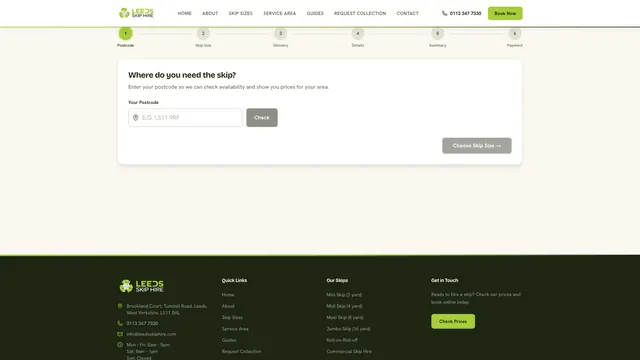
Waste management
Leeds & Wakefield Skip Hire
Replaced two WordPress/WooCommerce skip-hire sites with statically exported Next.js builds and a purpose-built booking API.
Read the project story
Transport compliance
Fleet Transport Consultants
Full rebuild of a HGV and PSV compliance consultancy's website, including a suite of free interactive compliance calculators.
Read the project story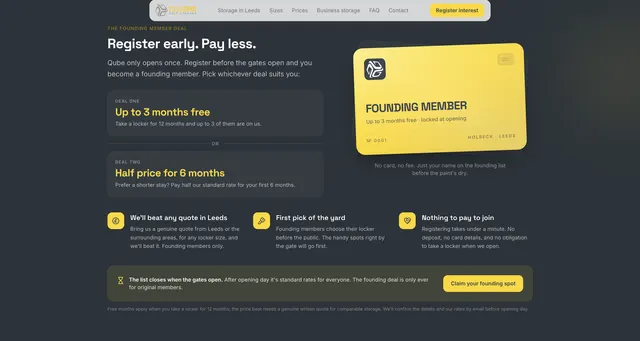
Self storage
Qube Self Storage
Pre-opening site and interest-capture funnel for a Leeds container storage facility, with a private CRM the owner works the lead list from.
Read the project story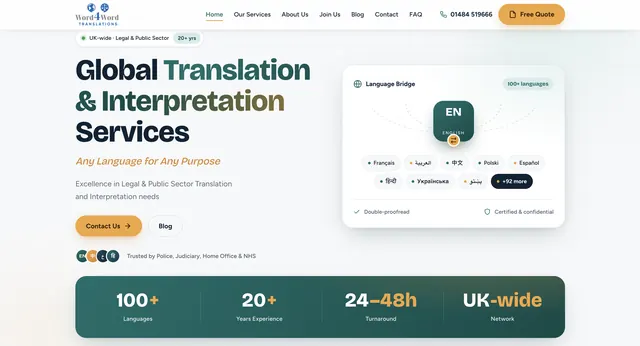
Legal & public-sector translation
Word4Word Translations
Rebuilt a legal translation company's website in Astro, with a Firestore-backed blog the client publishes to instantly.
Read the project story
Waste management
EFR Skips & Onyx Recycling
Online booking and payment for two skip-hire brands, plus the internal operations platform their office and drivers run on.
Read the project storyWhat's included
- A technical SEO audit of what you already have: crawlability, indexability, redirect chains, canonical conflicts, internal linking, and a full inventory of every URL search engines have already indexed.
- A page architecture and URL structure agreed before anything is built, on Fleet Transport Consultants the navigation, the breadcrumbs and the JSON-LD graph are all rendered from one shared library and each page is written to its original URL, so they cannot quietly fall out of step.
- Local landing pages written per area rather than templated with the place name swapped. 39 of them across the LS and WF postcode districts for Leeds and Wakefield Skip Hire, each with its own content.
- Structured data as a single cross-referenced JSON-LD graph covering the types that genuinely apply (ProfessionalService, Article, Breadcrumb, FAQ, Product) instead of separate blocks pasted per page that end up contradicting each other.
- An llms.txt file and per-crawler robots rules that name the AI crawlers explicitly, so you decide which ones are allowed to read the site rather than finding out afterwards. Both skip-hire sites and the Fleet Transport Consultants build carry them.
- A migration redirect map covering every previously indexed URL, written against the old URL list before launch. 45 permanent redirects across the two skip-hire sites, redirects preserving previously indexed pages on the EFR Skips and Onyx Recycling rebuild, and a migration pipeline that carried 37 articles and 7 pages verbatim onto Word4Word Translations' new site.
- Performance handled inside the build rather than chased afterwards: static output wherever the page allows it, responsive AVIF and WebP art direction with sized fallbacks so nothing shifts as it loads, and self-hosted variable fonts.
- Branded share cards generated at build time from each page's own heading, so a link pasted into WhatsApp, LinkedIn or Slack looks deliberate. Fleet Transport Consultants has 133 of them, one per page, and they rebuild from source.
How it runs
- 1
Audit and URL inventory
We crawl the site as it stands and build a list of every URL search engines already know about, the same inventory the 45 redirects on the skip-hire rebuild were written from. We read what a crawler receives rather than what your browser shows, check the robots rules, the sitemap and the structured data that is genuinely being parsed, and note where pages compete with each other for the same query. You get a written list of problems in priority order, with anything that risks losing visibility you already have at the top. There is no score out of a hundred.
- 2
Page plan and architecture
We agree the page set before anything is written: which services get their own page, which areas earn one, which guides answer questions people actually ask. Restraint matters as much as volume. Qube Self Storage has thirteen pages, including a location hub, size and price guides and four use-case pages, because that is what a facility that has not opened yet needed. The two skip-hire sites needed 39 district pages between them, because the two brands serve neighbouring areas across the LS and WF districts.
- 3
Build
Schema, sitemap, llms.txt, robots rules, redirects and image handling go into the site itself rather than being bolted on later. The redirect map is written and tested against the old URL list before launch, not after someone notices pages have gone. Where a business is not trading yet we leave markup out on purpose. Qube's structured data omits pricing, opening hours and ratings until the site opens, so the markup never asserts something that is not true.
- 4
Launch and verification
We check that the URLs search engines already knew about resolve where the redirect map says they should, then submit the sitemap and request indexing. Indexing is not immediate and neither is the effect of any of this, and we will not pretend otherwise. Continued work afterwards is optional and quoted separately, you can take the build, have the foundation right, and write your own content from there.
This is a good fit if
- Businesses that sell into named places, waste, storage and other service businesses working defined towns, districts or postcodes.
- Anyone replacing an existing site, particularly a WordPress or WooCommerce one, who cannot afford to lose the pages search engines have already indexed.
- Consultancies and professional services whose expertise is the product, where the site has to answer real questions in full on the page rather than gate them behind a call.
- Owners who would rather pay once to get the technical foundation right than rent a monthly retainer whose output they cannot inspect.
Probably not, if
- You want a guaranteed position, a traffic forecast or a date by which you will be first for a term. We will not write one, and an agency that puts one in a proposal at the quoting stage is telling you something useful about how it works.
- You want a monthly content and link-building retainer. We do not do outreach, digital PR or link acquisition, we have no work that would justify charging you for them, and a specialist will serve you better.
- You run a large catalogue or a multi-country store, thousands of products, faceted navigation, hreflang across several markets. Our work has been service businesses and content sites, and you should make whoever you hire show you the equivalent before they take the job.
Want a price for this?
Tell us what you need. We aim to reply within one working day, then agree the scope and a fixed price before work starts.