Custom software, CRMs and business systems
Bespoke software for the way your company works. We build custom CRMs, customer portals and internal tools that keep enquiries, customer records and day-to-day work connected.
Full bespoke CRMs: typically £5,000–£8,000 · 4–8 weeks depending on scale. Add a website redesign for typically £1,000–£2,000 when purchased alongside a CRM.
Relevant projects
Self storage
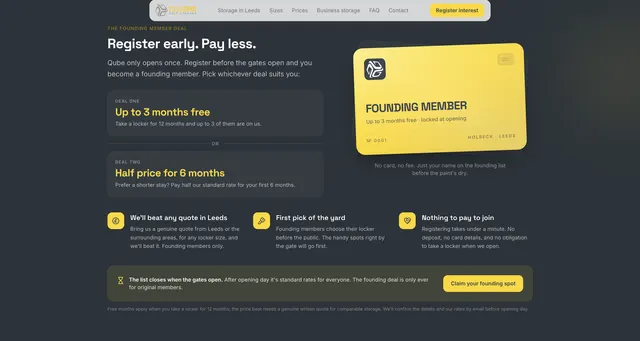
Qube Self Storage
Pre-opening site and interest-capture funnel for a Leeds container storage facility, with a private CRM the owner works the lead list from.
Read the project story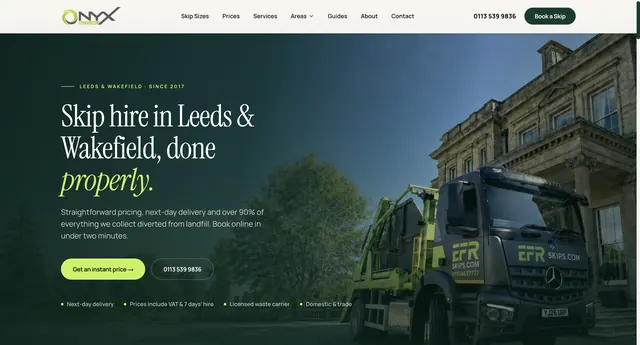
Waste management
EFR Skips & Onyx Recycling
Online booking and payment for two skip-hire brands, plus the internal operations platform their office and drivers run on.
Read the project storyWhat's included
- A map of the workflows, records and exceptions the system needs to handle.
- Custom CRM screens, customer portals or internal tools agreed against that workflow.
- User roles and permissions that reflect who needs to see, change or approve each record.
- Integrations with named existing tools, subject to their available APIs and account access.
- A scoped data migration, sample checks and a launch plan agreed with your team.
- Working previews, handover guidance, account access and three months of support and bug fixes.
How it runs
- 1
Map the work, not the wishlist
We start by watching how the job is done now: the spreadsheet, the whiteboard, the WhatsApp group, the exceptions nobody ever wrote down. What comes out is a plain-English model of the records, the statuses, the rules and the awkward cases that break naive software. The scope is agreed from that document before anything is built. If the map shows an off-the-shelf tool would do the job, you hear it at this point rather than after paying for a build.
- 2
Build the painful part first
We build in slices you can use, starting with whatever costs you the most time today, which is often scheduling or invoicing. You see working previews as we go, on your own data where we can, so feedback lands while it is still cheap to act on. Design and development run together rather than in sequence. Nothing waits for a reveal at handover, because the version in your head and the version we built are never quite identical, and the sooner that surfaces the cheaper it is.
- 3
Plan the migration and switch-over
We review exports from your existing tools, agree which records need to move and check a sample import before the full migration. Your team checks the data and key workflows against the old process. The launch plan names who signs off the results, how we handle a problem and when the old system can be retired.
- 4
Hand over, then keep going
You get the system, the accounts and the parts you can change without us. Qube's owner edits copy and unit details straight from the database with no redeploy; Word4Word publish blog posts from a private admin portal with a word-processor-style editor, and a post is live the moment they hit publish. Anything structural stays with us: we host it and keep building. You deal with the people who wrote the code, so there is no account manager in the middle, and the next round of changes is part of the relationship rather than a fresh procurement exercise.
This is a good fit if
- Businesses running real operations on spreadsheets, a shared inbox and phone calls, where everybody knows the process but nothing enforces it and the knowledge sits with two or three people.
- Operations with physical or regulatory constraints no general tool models properly, vehicles, sites, shift patterns, compliance windows, one-job-at-a-time capacity rules.
- Owners who want customers to serve themselves instead of ringing the office to extend, amend or pay for something.
- Firms whose expertise is the product, who want part of it turned into a tool a client can use directly: calculators, scored assessments, anything where you currently answer the same question by hand every week.
Probably not, if
- If a standard CRM, an accounting package or an established job-management app already fits how you work, buy it. Custom software costs more up front, and it only repays that when the fit is the whole point. We would rather say this on a call than take the work and hand you an expensive version of something you could have subscribed to.
- If the process is not settled, a custom system will harden the confusion rather than fix it. When three people describe the same job three different ways, or the way you work is still changing month to month, the order of operations is to sort the process out first. That is a short consultation, not a build, and it is a much cheaper mistake to avoid than to undo.
- If your procurement requires formal security certification, a named supplier with staffing cover, or a multi-year programme run through a change-control board, we are not that supplier. We are a small team you get direct access to, and that is the trade-off in both directions: quick decisions and no layers, but no enterprise apparatus standing behind us either.
Before you get started
Should we build a custom CRM or use an existing tool?
Start with an existing tool if it fits your sales process. A custom CRM is worth exploring when the important work involves unusual records, permissions, customer portals or operational rules that a standard setup does not handle well. We map those gaps before recommending a build.
What determines the price and delivery time?
Full bespoke CRMs typically cost £5,000–£8,000 and take 4–8 weeks, depending on scale. Workflows, user roles, integrations and migration determine the final scope. These are planning ranges, with a fixed quote and schedule agreed before building. A website redesign purchased alongside the CRM typically adds £1,000–£2,000.
Can our existing data and tools come with us?
We review the available exports and APIs before including an integration or migration in the scope. Agree which records must move, how duplicates are handled, who checks the result and how the switch-over works. The proposal names the systems included rather than promising that every tool connects automatically.
What about access, ownership and ongoing support?
The proposal sets out accounts, code and data handover, user access and any licensed third-party services. Three months of support and bug fixes are included, followed by an agreed monthly plan. Hosting, maintenance and additional development are made explicit so you can plan the ongoing cost.
Want a price for this?
Tell us what you need. We aim to reply within one working day, then agree the scope and a fixed price before work starts.