Managed web hosting and maintenance for UK businesses
The sites we build are deployed on Firebase, and they stay with us afterwards. That covers the boring, load-bearing parts of running a website: the certificate, the headers, the redirects, the dependency updates, and the person you email when something looks wrong. It is not a separate product we resell on. It is the same configuration we write into every project we ship, from the skip-hire booking platforms behind EFR Skips, Onyx Recycling and Leeds & Wakefield Skip Hire to the 138-page compliance site we generate from source for Fleet Transport Consultants.
Hosting is where a good deal of the security and performance work actually lands. Firebase handles HTTPS and certificate renewal; we handle everything above it. Headers are configured for the site in front of us rather than pasted in, and tightened as far as that site's own scripts and embeds allow. On Cal Roulette, our in-house product, that means a strict content security policy and full header hardening on an installable offline build. The rest of the work is done by keeping the output static: Leeds & Wakefield Skip Hire are statically exported Next.js builds, Word4Word is a static Astro build, and Fleet Transport Consultants' 138 pages are written to disk by a small generator we wrote for them. There is no runtime framework on the critical path and no server of yours to patch.
Maintenance is the other half, and it is less dramatic than it sounds. Sites rot in predictable ways. A dependency picks up a vulnerability. A form endpoint quietly stops delivering. A page is moved and nobody adds the redirect. A credential on a third-party service expires. The work is finding those things before they become an outage, and being reachable when something needs changing. It helps that there is less to rot than usual: the moving parts on our builds are deliberately few and deliberately known, a booking API, a Cloud Function behind a hosting rewrite, a database an admin area writes to, so the list of things that can fail quietly is short, and we wrote all of it.
Relevant projects
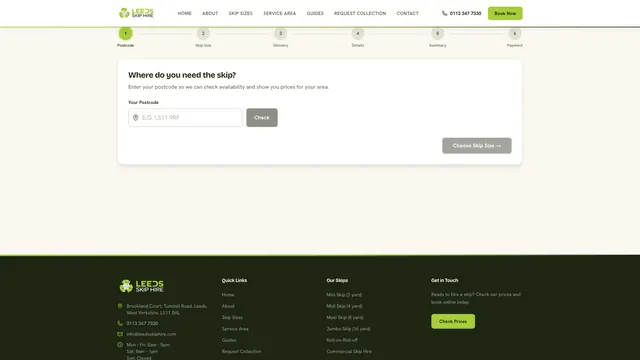
Waste management
Leeds & Wakefield Skip Hire
Replaced two WordPress/WooCommerce skip-hire sites with statically exported Next.js builds and a purpose-built booking API.
Read the project story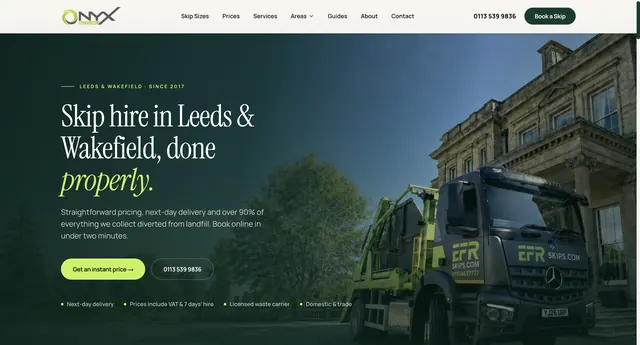
Waste management
EFR Skips & Onyx Recycling
Online booking and payment for two skip-hire brands, plus the internal operations platform their office and drivers run on.
Read the project story
Transport compliance
Fleet Transport Consultants
Full rebuild of a HGV and PSV compliance consultancy's website, including a suite of free interactive compliance calculators.
Read the project story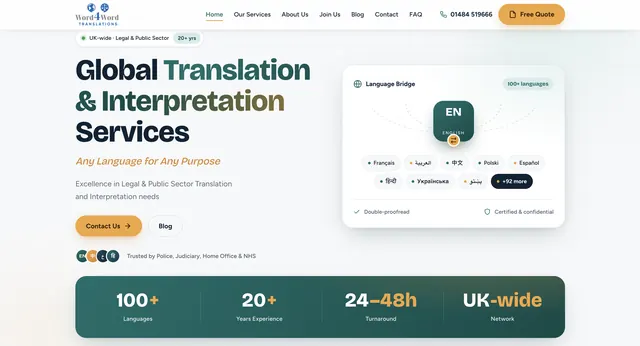
Legal & public-sector translation
Word4Word Translations
Rebuilt a legal translation company's website in Astro, with a Firestore-backed blog the client publishes to instantly.
Read the project story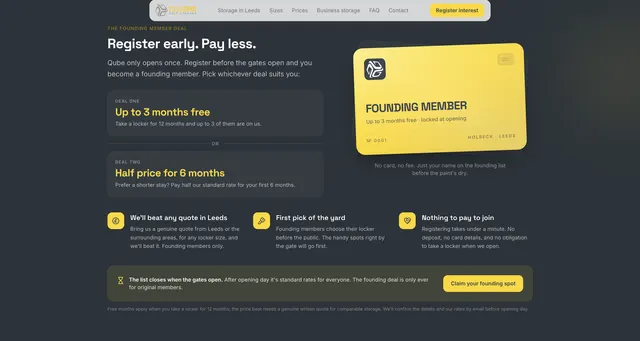
Self storage
Qube Self Storage
Pre-opening site and interest-capture funnel for a Leeds container storage facility, with a private CRM the owner works the lead list from.
Read the project story
Engineering consultancy
Aziz Consultancy
Marketing and enquiry site for an independent engineering management consultancy serving manufacturers.
Read the project storyWhat's included
- Deployment and hosting on Firebase. Hosting for the static builds, App Hosting where a site needs a server, as with Qube Self Storage, with HTTPS and certificate renewal handled by the platform, and your domain pointed at it correctly on both the apex and the www subdomain.
- A security header set and content security policy configured for the site in front of us rather than copied in, tightened as far as that site's own scripts and embeds allow, as on Cal Roulette's installable offline build.
- A redirect map that is maintained rather than written once, the Leeds & Wakefield rebuild shipped with 45 permanent redirects mapping every previously indexed WooCommerce URL to its new home, the EFR and Onyx migration came off its legacy sites the same way, and new entries get added whenever a page moves.
- URL preservation on a rebuild, and the structured data that goes with it kept current rather than left at launch state. Fleet Transport Consultants' 138 pages were regenerated to their original URLs, with a consolidated JSON-LD graph, llms.txt and explicit AI-crawler permissions alongside them.
- Dependency updates and audits on projects with a build to run them against, and the test suites that exist kept passing. Cal Roulette's database security rules have a dedicated suite run against an emulator, and it runs before anything ships.
- Rollback to the previous release when a deploy causes a problem, because Firebase Hosting keeps prior releases rather than overwriting the live one.
- Secrets held in managed secret storage instead of environment files sitting in a repository, which is how the Aziz Consultancy enquiry pipeline binds its mail credential.
- Content changes you make yourself where we have built for it: Word4Word publish blog posts from a private editor and see them live with no redeploy, and Qube edit page copy and unit details straight from the database, both without us.
How it runs
- 1
Take-on and audit
Before anything moves, we look at what is actually running. Where DNS points, what the current host is doing, which URLs search engines have already indexed, where form submissions end up, and which credentials are sitting somewhere they should not be. You get a written list of what we found and what we would change, including the things we think you can safely leave alone. If your site was not built by us, this is also where we tell you honestly whether it is something we can maintain or something that would need rebuilding first.
- 2
Migration and cutover
If the site is moving to us, the redirect map is written before the switch rather than patched together afterwards. When we replaced two WordPress and WooCommerce sites for Leeds & Wakefield Skip Hire, every previously indexed URL was mapped to its new home; the EFR and Onyx migration was handled the same way, with redirects preserving previously indexed pages. DNS time-to-live values come down in advance so the switch is quick and reversible, and the old site stays reachable until the new one is confirmed serving.
- 3
Running it
Once you are live, the work is routine and mostly invisible. Dependency updates and audits. Header configuration kept current as the site changes. Redirect entries added whenever a page moves. Checks on the parts most likely to fail quietly rather than loudly, contact forms, card payments, transactional email. Qube's registration pipeline sends two emails on every signup, a confirmation to the registrant and an internal alert linking straight to the lead; a site that has stopped sending those looks perfectly healthy from the outside, which is exactly why it gets checked.
- 4
Changes and support
You email or call the person who built the site. There is no account manager in between and no ticket queue. Small changes get done. Anything larger is scoped and priced before it starts, the same way the original build was, so a request never turns into an open-ended invoice. And where we have built an admin area. Word4Word's post editor, Qube's owner-editable content and its private lead CRM behind Google sign-in, you do not need us for day-to-day edits at all, which was the point of building them.
This is a good fit if
- Businesses whose site we built or rebuilt, and who would rather one team owned the design, the code and the infrastructure than split it across three suppliers who each blame the other two.
- Owners tired of paying a developer for every text change. Where content genuinely changes often, we build the editor and hand it over, as we did for Word4Word's blog and Qube's page copy and unit details.
- Sites where the front end is static or statically exported and the moving parts are deliberately few. That is most of what we build, and it is the main reason ongoing maintenance stays modest.
- Businesses with something transactional behind the site (bookings, card payments, enquiry pipelines) where a quiet failure is expensive and someone needs to be watching the plumbing, not just the homepage.
Probably not, if
- You want your existing WordPress site kept patched where it is. We do not maintain WordPress or WooCommerce installations. When we have met them, our answer has been to rebuild the site without them, as we did for Leeds & Wakefield Skip Hire, which is a project with a fixed scope and price, not a maintenance plan.
- You need a 24/7 on-call rota, out-of-hours incident response or a contractual uptime guarantee with penalties attached. We are a small team and you get the people who wrote the code, which cuts both ways: direct answers in working hours, not an overnight pager.
- You need mailboxes, a control panel or root access to a server you administer yourself. We deploy to Firebase and manage the configuration as code. If your requirement is cPanel, a VPS you can SSH into, or email hosted on the same account as the website, a traditional host will serve you better and cost you less.
Want a price for this?
Tell us what you need. We aim to reply within one working day, then agree the scope and a fixed price before work starts.